Disclaimer: All the views expressed in the piece belong to the author alone and do not necessarily represent the Women’s Resource Center’s offfical stance.
Author: Lee*
*For their own safety, the author is using a pseudonym
Due to its significant contributions to global health and multilateral organizations, the United States has an outsize effect on the way sexual and reproductive health and rights (SRHR) programs are framed, funded, and available throughout the world.
Following the results of the 2024 US presidential election, a number of questions were raised: to what extent the SRHR would be affected, whether the global gag rule would be reintroduced, and whether diplomats and foreign service officers would attempt to reinvigorate a coalition of signatories to the Geneva Consensus Declaration.
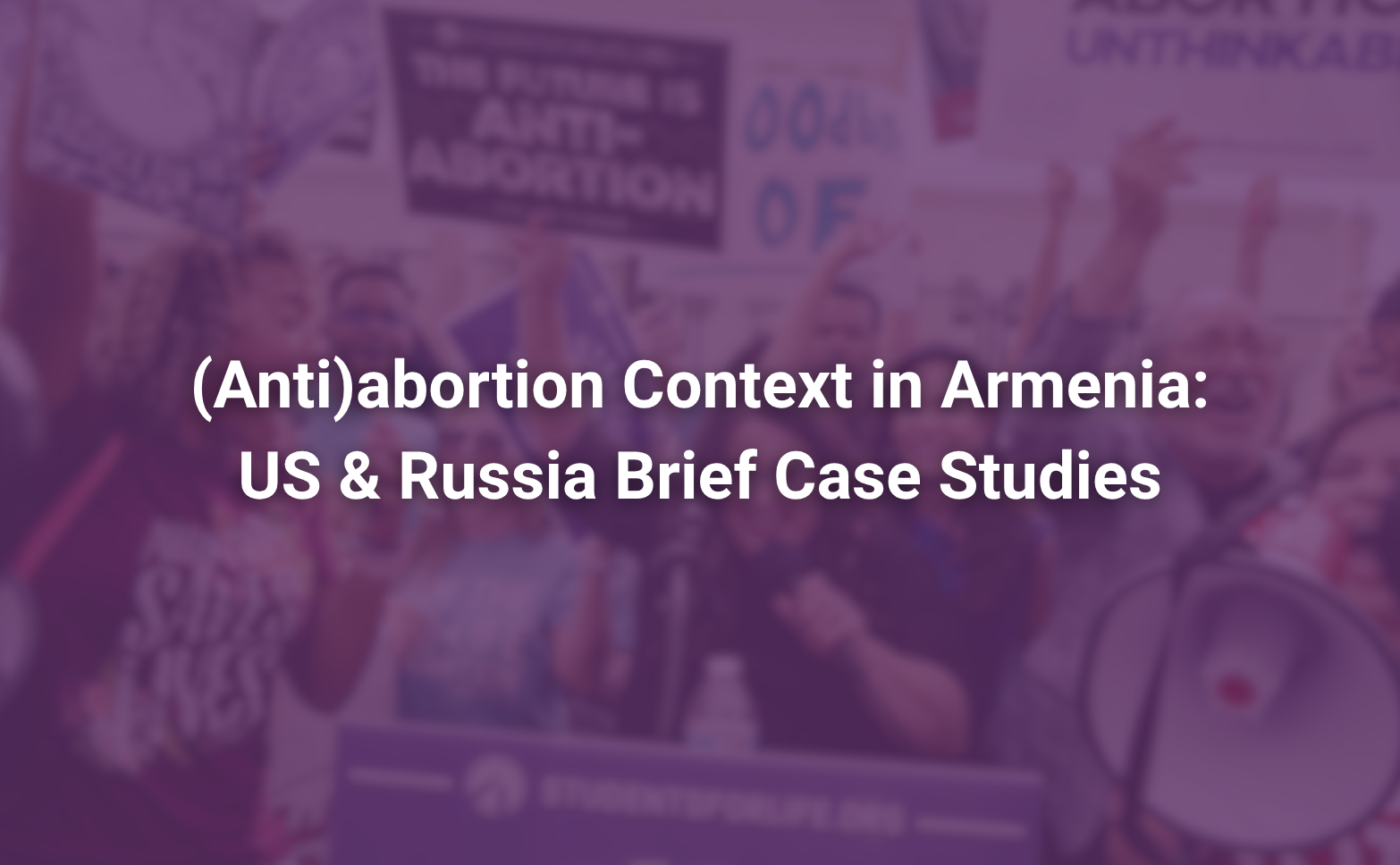
With knowledge of the events during President Trump’s first term, it was evident that both domestic and foreign policies would involve, among other things, justification for initiatives that infringe on human rights and the incentive of the anti-abortion movement. And while organizations that provide information on reproductive health and/or abortion services around the world would receive reduced funding or none at all, anti-abortion organizations would receive even more.
According to the EPF report, The Next Wave: How Religious Extremism Is Regaining Power, US funding in European initiatives opposing LGBTQ+ and reproductive rights came to $104.3 million between 2019 and 2023.
US anti-gender actors can be placed in three categories: the litigators, the civil society organizations and the right-wing and libertarian think tanks. Through these actors, the US has helped shape an international environment that is increasingly hostile to certain SRHR advances.
Russian “Traditional Values” At Home and Abroad
Another big actor in the promotion of anti-gender initiatives is Russia: between 2019 and 2023, it’s estimated that the country spent $211.8 million on anti-gender initiatives, primarily on anti-abortion activism.
This financial activity has been mainly limited to the Russian Federation on account of international sanctions imposed since 2014. Furthermore, following the full-scale invasion of Ukraine, attention to domestic abortion policy and the promotion of “traditional family” norms has intensified.
One possible source of funding for anti-abortion NGOs in Russia may be the Presidential Grant Foundation, where one can submit an application for a grant for one’s project under the category of “support for family, motherhood, fatherhood and childhood”. Between 2019 and 2023, the Presidential Grants Foundation awarded 57 grants for abortion prevention, totaling $1.56 million.
In 2023, regional laws prohibiting the “inducement” or “incitement” of abortion have started to be enacted through the Women for Life foundation, which is one of the biggest Russian anti-abortion organizations, with over 20 regions currently implementing this ban. At the same time private clinics were urged by authorities to stop performing abortions, as well as drugs used for medical abortions were reclassified as controlled substances, complicating their availability.
Women for Life also plays an important role in foreign policy. Since its foundation in 2016, it has held roundtables, participated in conferences, and developed relations with representatives of pro-life and far-right groups in Serbia, Georgia, and Belarus. Moreover, the “Hello, Mom” (“Zdravstvuy, mama”) project, which served as the basis for the anti-abortion laws mentioned earlier, is being actively promoted in Belarus.
Russia has a range of tools at its disposal that allow it to maintain its influence or impose its interests on post-Soviet countries. Mostly, it exports gender stereotypes and patriarchal values abroad to gain the backing of conservatives in different societies. One of the most recent examples is its attempt to influence the 2025 elections in Moldova through propaganda campaigns and digital manipulation aimed at undermining pro-EU forces.
Furthermore, Russian influence can be seen in the legislative processes of other countries. For instance, Hungary, Slovakia, Serbia, and Georgia have proposed or passed ‘copycats’ of Russia’s foreign agent law, resulting in less accountability for corruption and limitations on freedom of expression. Another example is Kazakhstan’s anti-LGBTQ+ law that was enacted by Tokayev, reflecting rhetoric similar to that of the Kremlin.
Armenia’s Abortion Landscape
Although abortion has been legal in Armenia since 1955, there is a discrepancy between public discourse and private practices. This is largely due to abortion being considered a form of contraception since the Soviet Union, and the simultaneous promotion of more traditional gender roles by the government as a result of nation-building, economic instability in the 1990s and the two Nagorno-Karabakh wars.
Abortion is legal up to 11 weeks and 6 days of pregnancy. From 12 to 22 weeks it is allowed only under special medical or social circumstances. In every case there is an obligatory consultation and 3-day waiting period before applying to abortion.
The waiting period is often criticized, as it undermines women’s autonomy in deciding on legal abortion, delays access to care and excessively burdens poor and rural women, as well as those subjected to domestic violence. Moreover, women in Armenia often have to face high cost of services, lack of clear information on legal rights and alternatives, and refusal of care by healthcare providers.
A few pro-life organizations are known to be active in Armenia today (e. g., Right to Life, ProLife NGOs). On the website of one of the biggest US anti-abortion organizations, Heartbeat International, information about “For Life Ministry” in Armenia, which provides pregnancy support, can be found. However, there are no details outside of the map, which suggests the branch is no longer operating. Nevertheless, pro-natalist messages and announcements of the registration of a new foundation, ProHaye, can be found on social media, shared by US citizens living in Armenia.
On the other hand, Russia’s influence is not specifically directed at SRHR, yet a significant part of it involves the promotion of “traditional values”.
With the same toolkit employed in Moldova – AI-enabled deception, websites designed to mimic legitimate news outlets, social media bots – Russia seeks to “minimize the electoral result of ‘Civil Contract’ and its allied political forces” in the 2026 parliamentary elections. This campaign primarily promotes the idea that the rapprochement with the EU would be harmful to Armenia, and is often intertwined with anti-LGBTQ+ rhetoric and gender issues.
Another noteworthy initiative is ANO Eurasia, which was established in 2024 with the objective of “countering anti-Russian propaganda and strengthening the Eurasian Community through public diplomacy”. The organization’s Armenian representative is Mikayel Badalyan, a blogger who actively spreads Russian propaganda on social media, including anti-gender and anti-EU narratives, which indirectly influences the discourse on SRHR and abortion in Armenia.
Conclusion
As we can see, both queer and women’s rights, specifically reproductive rights, are forced to suffer for the sake of geopolitical interests.
Both the US and Russia influence abortion policy in Armenia, but to varying degrees. At the moment Armenia is trying to decrease its reliance on Russia and integrate closer with the EU, which is perhaps why the US is not in the picture exactly.
The question is, to what extent Armenia would be affected? And is it possible to maintain good relations with Russia without sacrificing the well-being of marginalized groups?
We should also understand that the upcoming elections are a turning point. It’s not just about reproductive rights but about Armenia staying democratic, prioritizing its people; or becoming authoritarian, leading to destruction of independent judiciary, propaganda and misinformation, corruption, suppression of freedom of speech and expression.