In recent days, we have seen public statements and media comments attacking women’s organizations as “silent,” politically compromised, or selective in defending women’s rights.
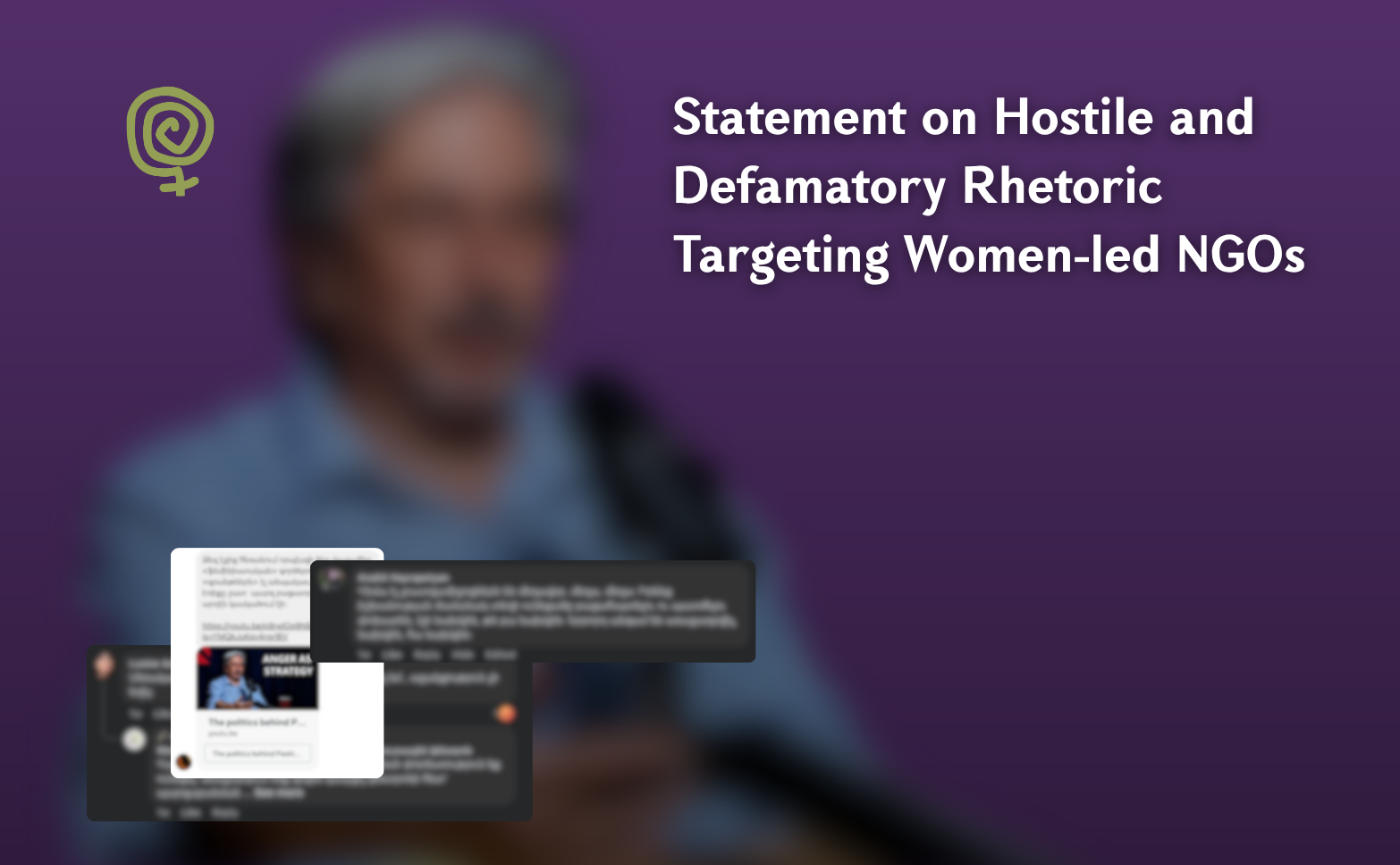
A recent example is the CivilNet video “The politics behind Pashinyan’s public outbursts,” published on 19 May, where the discussion touched on the supposed “silence” of women’s organizations. We mention this as one example of a wider pattern where criticism of political forces can easily turn into unfounded labeling and delegitimization of women-led organizations.
We consider these statements irresponsible, misleading, and harmful.
Women’s civil society organizations respond publicly to cases not because of political controversy, according to media pressure, partisan expectations, or public shaming. Instead, decisions about public advocacy are shaped by many factors: survivor autonomy, verification of facts, safety concerns, organizational mandates, resources, and strategy.
It is legitimate to disagree with an organization’s position, timing, or decision not to issue a statement. What is not legitimate is to use that disagreement to question whether women’s organizations are “real” civil society, accuse them of bad faith, or suggest without evidence that they are controlled or silenced by the government, embassies, or political interests.
This is not constructive criticism. It is delegitimization.
We also reject the expectation that women’s organizations must act as a public defense mechanism for every woman. Our mandate is not to provide unconditional protection to all women because they are women. There is an important distinction to be made. An argument or disagreement between a man and a woman is not automatically sexist or patriarchal. What matters is the context, the power dynamics, the language used, and whether the situation reflects gender-based violence, discrimination, structural inequality, or violations of rights, which are the issues women’s rights organizations are mandated to address. Still, we expect politicians and public figures to act with responsibility and dignity, and not normalize degrading or hostile public discourse.
We are also concerned that, too often, men in political or media spaces publicly instruct women’s organizations on when to speak, how to speak, and what position to take. This kind of patronizing pressure does not strengthen women’s rights work. It reproduces the same power dynamics and gendered hostility that women’s rights organizations have long challenged.
We also note the striking selectivity of many of these attacks. The same individuals who now aggressively demand statements from women’s organizations are overwhelmingly silent on domestic violence, sexual violence, discrimination against marginalized groups, and other systemic human rights violations affecting women and vulnerable communities in Armenia. This demonstrates that their concern is not genuinely centered on women’s rights, but rather on politically targeting, discrediting, and undermining feminist activists and women-led civil society organizations. We are concerned by the fact that CivilNet, having been covering women’s rights and the work of women’s organizations for many years, shares such a view as well.
Women’s organizations in Armenia have worked for years under enormous pressure: supporting survivors of violence, advocating for legal reform, documenting discrimination, building services, and defending women’s and marginalized groups’ right to participate in public life. To dismiss this work because of disagreement over specific political moments is unacceptable.
Civil society independence means the right to decide how we work, when we speak, what language we use, and what strategies we choose. It does not mean performing outrage on demand.
Public discourse should not normalize attacks on women-led civil society simply because we refuse to submit to impossible political purity tests.
We call on media actors, public commentators, political figures, and civil society colleagues to engage responsibly, without stigmatizing, instrumentalizing, or delegitimizing women’s organizations and civil society as a whole.
NGOs joining the statement:
– Women’s Resource Center
– Women’s Support Center NGO
– Coalition to Stop Violence against Women
– Coalition of Support Centers Against Domestic Violence
– Human Rights House Yerevan
– Women’s Fund Armenia
– “Socioscope” Research Center NGO
– Pink Human Rights NGO
– Sexual Violence Crisis Center NGO
– Women’s Center: Shushi
– “Agat” Center for the Protection of the Rights of Women with Disabilities NGO
– “Women’s Rights House” NGO
– “Real World, Real People” Social NGO